Upon first smell and glance, an oyster cage is disgusting. It’s fishy, muddy, dirty, wet, sloppy, messy, and gross. But, it is also teeming with life, and full of an opportunity for human beings to help redeem our waterways, and connect to the creatures that sustain it. Reframing and deconstructing disgusting or ugly things is an intrinsic part of Alexandra’s artistic practice and this project. By exploring the human impact/interactions with oysters through her art, Alexandra hopes to discuss how people can help oysters, and further the Billion Oyster Project’s mission. To do this, the artist has utilized recycled, reclaimed, and reused glass to create a juxtaposition of purity and impurity and explore the contrasts between glass as a pure, light, effervescent material, and the oyster as a mucky, often-forgotten subject that is a scientifically, historically, and culturally important part of New York waterways. To recycle glass, she collected liquor bottles from Billion Oyster Project’s restaurant partners. Through UrbanGlass, Alexandra reclaimed glass that was not being used by other artists. Additionally, she reused pieces that were not able to work in different shops because of their quality. Before the Industrial Revolution in America, glass factories crushed up oyster shells and burned them to create mixes for glass used for blown glass. The interaction between oysters and glass is rooted in New York Harbor history. However, this is no longer the case for many reasons. That being said, the interplay between how New York oysters are perceived as dirty and how glass is perceived as sterilely beautiful is an important part of this work. The artist has created four parts of this exhibition to explore these themes and ideas.
Water Testing: Solid, Kiln Formed, Reef Structure
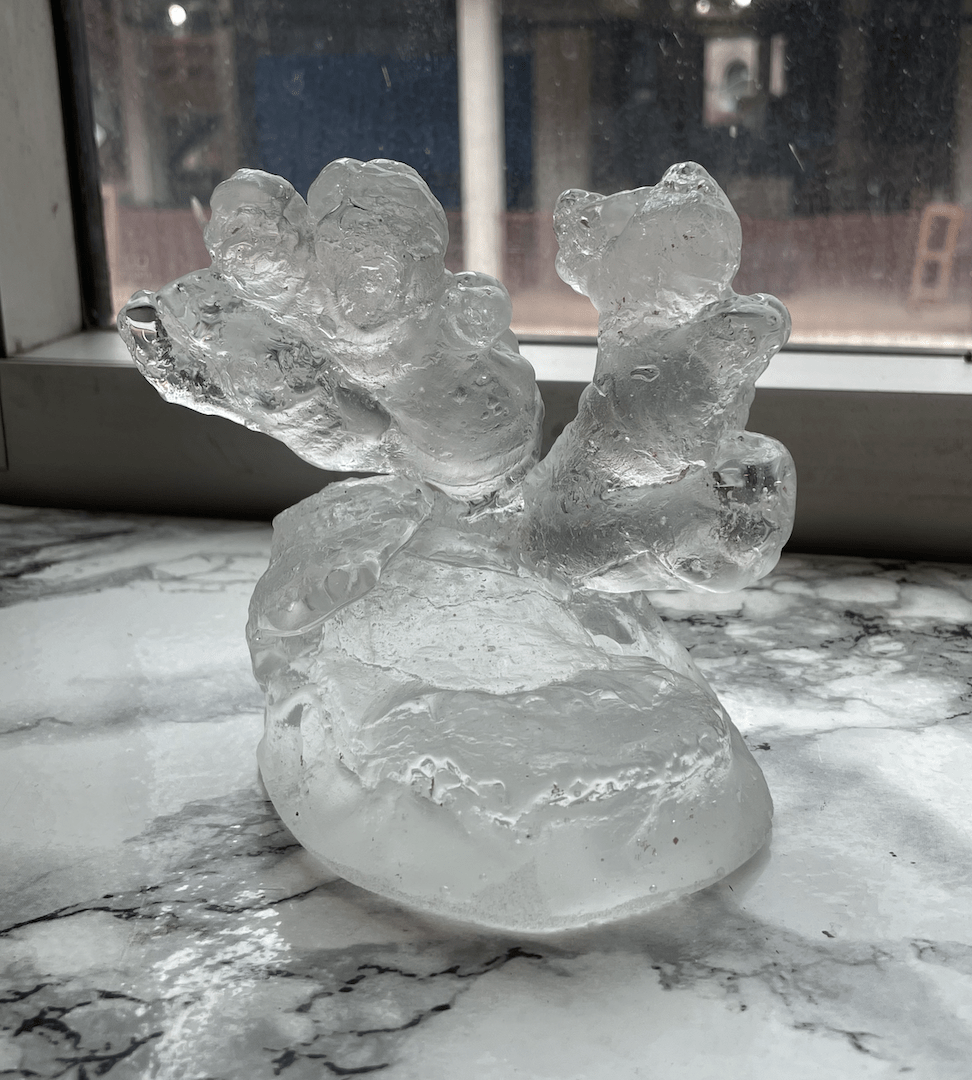
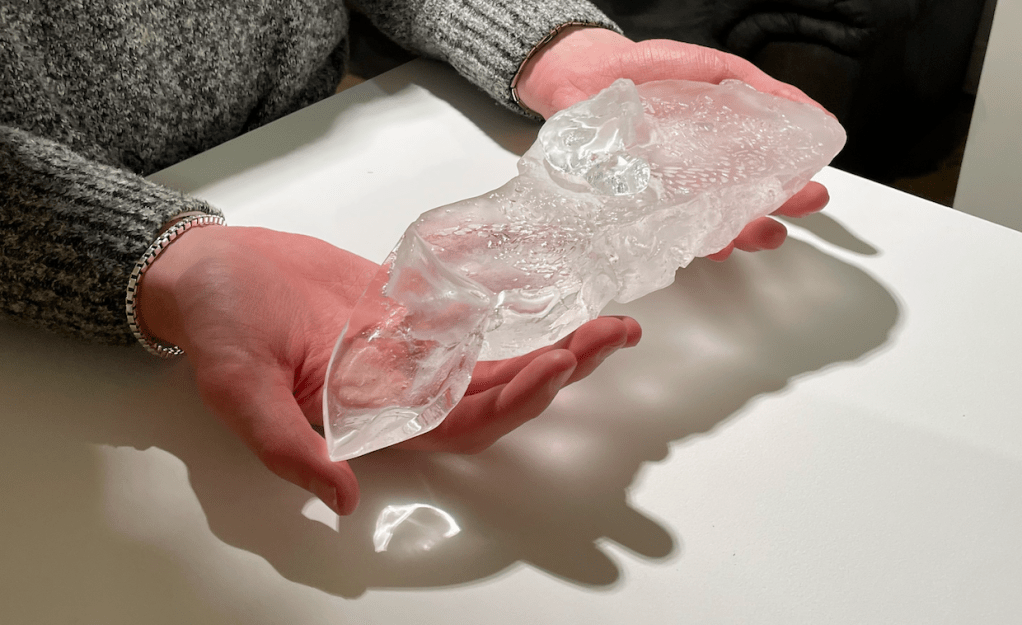
To demonstrate how oysters can create a reef structure beneficial for multiple species, Alexandra created a glass oyster cluster with red beard sponges growing out of it. She was inspired by the contrast of the shapes, textures, and colors of the sponges, compared to the oyster itself. The sponge in real life is an orange color; it’s soft and squishy, whereas the oyster is rigid and dark brown. However, the entire glass piece the artist created is transparent. Some areas of the oyster retain the smooth clear nature of glass, while others are rough and opaque to resemble the way other organisms live on the oyster reefs and sometimes affect their growth. This object is created from cullet glass, which is a type of reclaimed glass from the UrbanGlass furnaces. Cullet glass is material that has been taken out of the furnaces because the quality is not up to the standards of what blown glass artists would like to use generally because of the clarity of the glass or other kinds of impurities. This cullet glass is then reused for kiln-formed glass projects, where the clarity and quality of the glass are less important. Kiln-formed glass almost always has a sheen or opaqueness to it because the glass that rests on a mold collects small plaster particles, which make the glass less clear than hot shop-blown glass. This piece is intended to be touched and experienced by viewers to combat the misconceptions that New Yorkers have that our waterways are teeming with toxins and industrial waste, which is no longer the case in most of our harbor. What is true, however, is that much of our water does have some level of heavy metal contamination, and/or combined sewage overflow (CSO). After completing Citizens Water Quality Testing, and being out on these waterways through ferries and boat trips throughout this internship, the artist has learned that even with this contamination, there are beautiful interactions between the humans and animals of these waterways — such as the oysters. Oysters create a habitat for many other creatures in the water. On Alexandra’s first day completing water testing, she saw a live oyster for the first time and was perplexed by how many sponges, sea squirts, algae, and small creatures lived on and among the shells. Alexandra, like many people, did not know that oysters are a keystone species because they form a natural storm barrier, build habitats, and filter the water (Kurlansky). Furthermore, these reefs can create a natural storm barrier during hurricanes and flooding events, which is why the artist wanted the glass oysters to be heavy, and solid to mirror their strength (Greenberg).

Kiln formed oyster with other oysters and sponges growing from the top
BEFORE/AFTER: Pure and Dirty Oysters
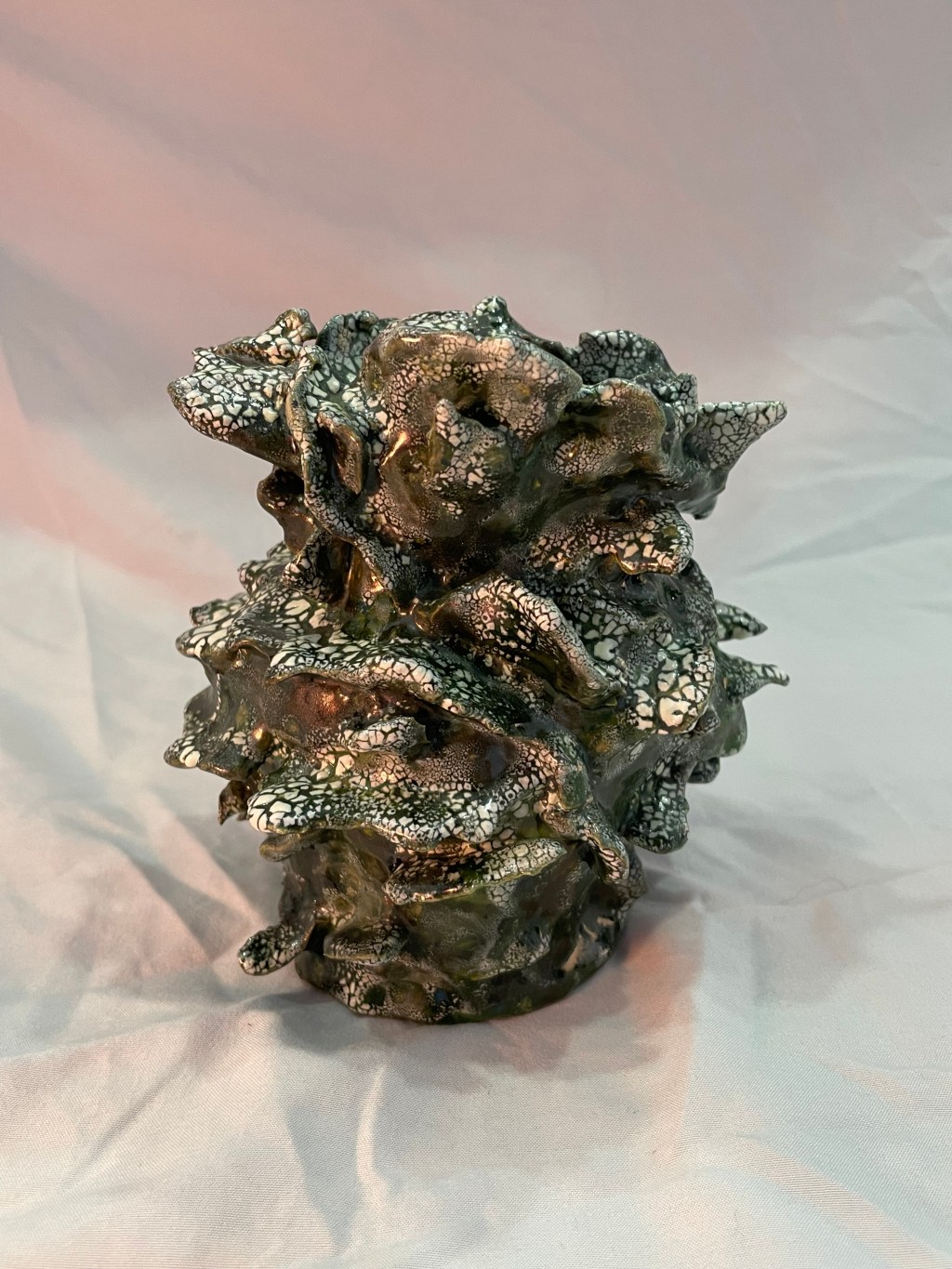
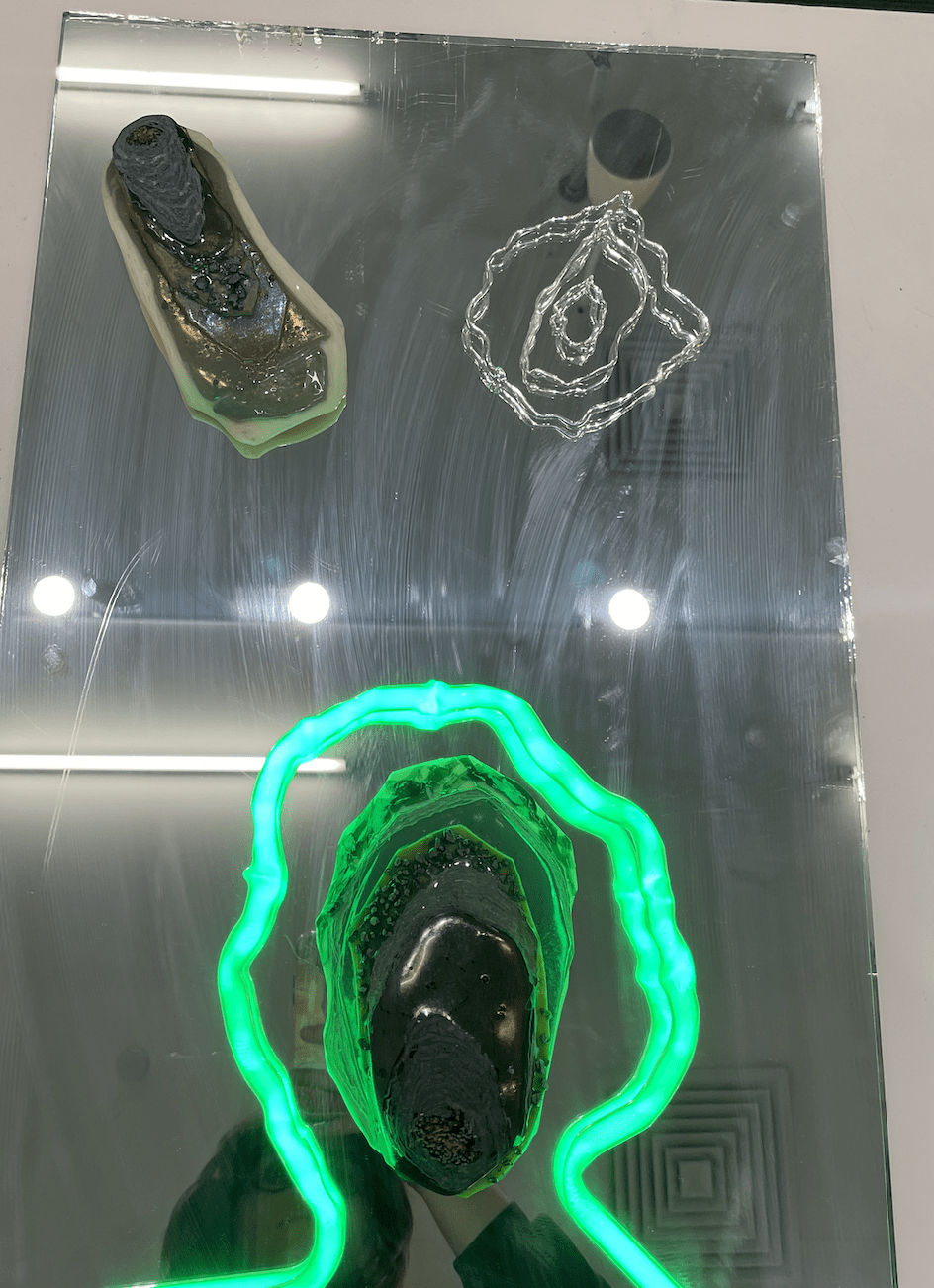
The next components of the exhibition are a white oyster shell, and a green, purple, brown, and black oyster shell, titled, Before/After. These represent the degradation humans have caused to New York’s once pristine, pure, waterways, specifically through the process of colonization, capitalism, and industrialization, (Kurlansky). The white oyster shell resembles a natural oyster through its ridges and white coloring, with just a hint of iridescence on the underside of the shell. The dark oyster is a mix of colors, iridescences, and textures, which resembles the sheen of oil that sits atop many of our waterways. The scale of this large piece is meant to depict how so much of our future will be devoted to cleaning up and restoring our waterways, through projects like the Billion Oyster Project. This piece is specifically inspired by the SuperFund Site, the Gowanus Canal. The Canal has a storied history, detailed in the New York Times: “Carved out of tidal wetlands and streams in the 1860s, the Gowanus evolved into a busy waterway for oil refineries, chemical plants, tanneries, manufactured gas plants and other heavy industry along its banks. Industrial waste and raw sewage gushed into the canal for over a century” (Navarro). The sewage and other waste now sit at the bottoms of the waterway, referred to as Black Mayonnaise, which inspired the name of the exhibition. The infamous Canal has been an issue as early as 1893 when residents over a mile away complained of the foul and putrid “miasmatic” and “odious” smells the canal emitted that impacted local business and the health of the community (“A Disgrace To Brooklyn”, New York Times). Continuing further back in history, during early Dutch settlement in the area, the oysters growing in this region were at one time over a foot long. They were then exported back to Europe for profit, which inevitably contributed to the overfishing that decimated our oyster population (Kurlansky). Prior to colonization, the Canal was a creek used by the Lenape people, and the Canarsee tribe, to fish and forage for a variety of plants and animals, especially around what is now Red Hook. Despite the work it will take to clean the Canal and regrow our plant and animal population, Alexandra included bits of glittery glass to show how there is something bright, and hopeful, about this future that the Billion Oyster Project and New Yorkers can create together. While the Gowanus Canal will not be home to oysters for many years and for many reasons, she wanted to reimagine what a “lifeless’ ‘ body of water is represented by through the ghosts of the animals from its part. From these spirits, the artist hopes that viewers will see the implications of polluting a body of water. Alexandra hopes that this encourages viewers to take responsibility for actions they can take to lessen their environmental impact and force the companies and politicians they support to do the same.

Close up of the “After” oyster

recycled bottles: Sandblasted Liquor Bottles
Through the Billion Oyster Project’s partnerships with various restaurants, Alexandra was able to collect and recycle glass wine and liquor bottles and transform them into the animals that rely upon the oyster for a habitat. She created animals on wine bottles by sandblasting creature prints onto old alcohol bottles. Sandblasting is a process that uses fine grains of sand shooting through a pressurized “gun” to strip away the topmost layer of glass and the sheen of it. Sandblasting is similar to a frosted effect on the glass, and it makes the glass feel velvety and soft, in contrast to the smooth coldness of un-blasted glass. This also impacts the way light travels through and reflects on the glass, diffusing light and making it softer. Generally, glass practitioners use sandblasting to imprint an image onto glass, which can be seen throughout the chandeliers at the Yellow House, where Alexandra spent time working through her internship. This method was used for these pieces as the stages of sandblasting strongly mirror ocean acidification, changing salinity levels, and the rising temperatures of our oceans. The high-pressure sand gun strips away the shine and topmost layer of glass, which is similar to the way that climate change, and capitalist human actions, are stripping away at our coastlines and habitats.
Sandblasting mirrors rising temperatures and changing pH levels because of the physical change that occurs in the glass and water. The oyster is deeply impacted by the pH of the water it grows in, which has been rapidly changing as a result of climate change. This means that the pH level is sinking because of increased carbon dioxide absorption by the water, which makes the water more acidic. Therefore, this acidification eats away at the minerals that help make an oyster shell, which is similar to sandblasting because of the physical process of stripping some material away. This imbalance impacts the entirety of the water column, starting with the oysters. Not only is the pH level of the water changing, but the temperature is also rising. The temperature of the water has overall increased, as well as marine heatwaves lasting much longer than before the 21st century. This temperature and pH change radically changes the way oysters grow, their taste, and their ability to thrive and reproduce. The change the oyster faces trickles down to various other species, like blue crabs, bristle worms, and many other species, because the oyster is a keystone species that creates a reef structure where other animals live. This also impacts humans because oysters help filter and clean the water, making it safer for us to be in and around these waterways. This is represented by sandblasting because the artist is stripping away at the glass, similar to stripping away at livable places for oysters, and our own ability to use our waterways.
Our access to waterways has, in some part, been taken away because of increased private ownership of waterfront properties, and gentrification of these neighborhoods, which is important to recognize as recreational access to water becomes more important as a result of climate change and increased heat. Waterways in New York have long been contested sites of ownership after the decline of industry in the 1960s, and the bankruptcy that followed in the 70s. But, from these endings came a new beginning on Pier 34 from 1983-4 when David Wojnarowicz and Mike Bidlo reclaimed that pier for artists as a massive collaborative space during the AIDS crisis. A space for artists to create together is a fever dream today, as so much of the waterway is blocked off, privately owned, or inaccessible to the public. There is a huge disparity between neighborhoods that have recreational access to parks and the waterways, which is largely economically and racially segregated, and echo the remnants of Robert Moses’ destructive and divisive city planning. However, steps are being taken to rectify these injustices through the opening of new public parks and waterfront spaces, such as Governors Island, where Alexandra spent much of her internship. Hopefully, as ferry access is improved over time, this will help more people reclaim their waterfront connections, and will give people a more intimate connection to the critters that live alongside them.
The two critters on clear bottles, crabs and bristle worms, live in our waterways. The oyster, the green bottle, supports their lives as a keystone species. The oyster is a sessile creature, meaning it does not move for almost the entirety of its life, which is differentiated through the slightly narrower shape and different colors of the bottle. Through this internship, Alexandra spent a lot of time learning not only about the oysters but also about handling animals that live among them. Before this internship, she had never touched a live blue crab or anything that came out of New York waterways. The artist wants these bottles to be as tangible as the New York harbor critters were to me. However, Alexandra can proudly say that she has handled many creatures and helped run programs to educate students about them, through her time working with middle and high school students.


Close up of bristle worm bottle

Close up of blue crab bottle
Water is Life: Hollow Vessel of Light
The final piece is a hollow, transparent glass oyster filled with light titled Water is Life, sitting on reflective, high visibility dark fabric that disperses the same purple, brown, and green colors, as Before/After. Though oysters have a rough texture along the bill, Alexandra wanted the ridges to also represent ripples in the water. Playing on this, when the hollow oyster is filled with light the ridges project those ripples onto the walls, the high-vis fabric underneath as well as the viewers themselves, she did not want viewers to be able to separate themselves from the light, the oysters, or the waterways because they are all interconnected and important for the future of New York Harbor. The interconnectedness of different species and the importance of balance is highlighted through the light. The purple, brown, and green colors in the fabric are a reminder of the toxins and heavy metals that threaten the oysters and the health of our waterways. Whereas the high-vis fabric pulls directly from the artist’s experience working on boats wearing life jackets while working to restore oysters in the harbor acting as a source of hope and light and drawing the views to internal reflection.

Close up of Water is Life

The many vessels created for this project
Rebirth from The Mother of Black Mayonnaise
Even though the health of our oysters and waterways is a threat, there is also something beautiful about it in the decay and death. The Billion Oyster Project represents life in a previously dead waterway; it is a way forward, to save the water, the oysters, the sponges, the seaweed, the fish, and ourselves. It is an opportunity, like the Harbor School, or our volunteers, to learn more about the rivers, get their hands dirty, and become directly involved in actions to save our waterways. It is a representation of the opportunity for our waterways to be reborn and reimagined, much like the glass Alexandra has reshaped for this project.
Works cited:
Cloern, JE. 2001. Our evolving conceptual model of the coastal eutrophication problem. Marine Ecology Progress Series 210: 223–253.
Max Liboiron, Introduction in Pollution is Colonialism (Durham: Duke University Press, 2021), 1-38.
Nicholas, George “When Scientists ‘Discover’ What Indigenous People Have Known for Centuries,” Smithsonian Magazine, 21 February 2018
Reeder-Myers, L., Braje, T.J., Hofman, C.A. et al. Indigenous oyster fisheries persisted for millennia and should inform future management. Nat Commun 13, 2383 (2022). https://doi.org/10.1038/s41467-022-29818-z
Greenberg, Paul. “An Oyster in the Storm.” The New York Times, 29 Oct. 2012, https://www.nytimes.com/2012/10/30/opinion/an-oyster-in-the-storm.html?searchResultPosition=11.
Kurlanski, M. The Big Oyster: History on the half shell. (Random House, 2006).
Maldonado, Samantha. “The Most Resilient New Yorkers: Oysters Get Second Life in Harbor.” Brooklyn Eagle, 2 Dec. 2022, https://brooklyneagle.com/articles/2022/12/02/the-most-resilient-new-yorkers-oysters-get-second-life-in-harbor/.
Mireya Navarro. “Gowanus Canal, Long Foul, May Go Green.” The New York Times, 2 Mar. 2010, https://www.nytimes.com/2010/03/03/nyregion/03gowanus.html.
“Disgrace to Brooklyn.” The New York Times, 1 Mar. 1893, p. 4. TimesMachine, https://timesmachine.nytimes.com/timesmachine/1893/03/01/106862207.html?pageNumber=4.
 Alexandra Faye Friedman