Stepping off the elevator, you step into the historical rooms of the Brooklyn Museum. They are recreations of upper-class and wealthy homes, with beautiful furniture, and lavish materials such as velvet, mahogany, and glass. It’s dark and moody. Then, as you pass through a small hallway covered in brightly colored wallpaper of what looks like fishing lures and other random objects like combs, the room opens up, incredibly white, open, and bright. This contrast is stark, but a necessary shock to the system to prepare the viewer for the rest of the exhibit. “Death to the Living: Long Live Waste” is an exhibit created by Duke Riley for the Brooklyn Museum, which runs until April. The show contains videos, sculptures, and drawings that Riley created to display the wide-ranging impacts of pollution. He creates scrimshaws, traditionally made by sailors on wha

lebones with illustrations to tell stories of travel, instead of plastic drink bottles, detergent bottles, and toothbrushes etched with ink (Riley “Mike Durant” (No. 37)).
In these pieces, he features people he believes are responsible for pollution, like CEOs and billionaires. He redirects attention away from consumers of plastics and focuses instead on the producers and creators of plastics, who have industry control. He amplifies and subverts the narrative that blames consumers for their own consumption and questions why consumers must make these choices. He also carves various iconic New York landmarks, like the statue of liberty, as well as some purely decorative pieces, and city animals, like pigeons, feeding their babies in a nest (Riley, Poly S. Tyrene Memorial Maritime Museum series).
The exhibit opens in a large room, with a video feed playing on one of the massive walls, showing Riley fishing in the Atlantic ocean using lures made out of tampons and other disposed items. The video is comedic, a spoof on traditional male YouTubers; full of sound effects and beer. There is something hilarious and giddy about the fishing and the charism Riley displays. At first, it’s unclear what Riley uses to catch fish, but as the video continues, the tampons are impossible to ignore. Riley does in fact catch a fish, and the video concludes lightheartedly, and the tone shifts downward as viewers walk through the exhibit (Riley, Welcome Back to Wasteland Fishing, Episode Two).

However, Riley uses the taboo and dirtiness of the tampon and disposal to illustrate the connection between taboo, trash, and dirt, which is a key concept in Mary Douglas’ work, Purity and Danger. Mary Douglas is the godmother to the modern discard studies movement, with her ideas becoming the basis for later understandings of different societies’ interaction with “dirt” and “taboo”. She writes, “there is no such thing as dirt; no single thing is dirty apart from the system of classification” (Douglas xvii). The tampon represents the ultimate dirt in American society because it is entrenched within the female reproductive system, and its intimate and close proximity to menstrual blood. But Riley handles the tampon lures with ease, therefore ignoring the classification system of what “dirtiness” is in society. Riley uses tampons throughout the exhibit, pointing to a larger issue of single-use plastics, especially related to personal hygiene (Riley, “Duke The Fisherman’s High-Quality Fluke Rigs Made in the USA ™”).

He also details the impact of all these bottles on the environments where the plastic collects. He sources some of the plastics and waste for his projects from a trash collector, Michele Klimczak, on Fisher Island, an elite enclave off the coast of Connecticut where rich families such as the Duponts live in the summer, therefore connecting/collecting trash at the metaphorical source. At the end of the exhibit, Michelle speaks for herself about this Sisyphean task, and how she does it every day, not for the wealthy, but to help the island she loves, and lives at full time, as a founder and member of the Fisher Island Conservancy. The video contains shots of her trudging up and down the beach, in the rain, the snow, and the sun, demonstrating her dedication to these beaches. Her figure buckles against the wind, the ocean roaring around her. The audience feels as though they are seeing a behind-the-scenes of sorts, especially as the video is at the end of the exhibit, and tucked away. It makes me question whether curators really wanted visitors to see this film, and why it was at the very end. However, Michele’s work relates to artist Mierle Laddermann-Ukeles, a prominent Discardian and the first artist in residence at the New York Sanitation department. Within her manifesto, and expressed via a discussion earlier this year, Ladermann-Ukeles states that “maintenance is a fucking drag; it takes all the time…. Everything I do is Art is Art”(Ukules 3). Ukules reject the avant-garde male artists of her time in the 1960s and 70s, who defined art narrowly and did not have “maintenance” tasks in the same way from gendered, racial, and class-based expectations. By defining maintenance as art, Ukules allow critics and viewers to have a broader definition of art, and who is an artist. In this way, Michele is creating art, regardless of the video documenting it. Furthermore, by maintenance being art, it reduces critiques about the usefulness and importance of art because if maintenance is necessary for societies to flourish (which it is), then so is art because they are the same. Riley’s, Ukuleles, and Michele’s work is necessary and important for all of us, despite their individual actions/expressions being different.
Going back to the fishing lure, Riley creates something of utility, and essentially value, which is an important part of discard studies, which can be explained in scholar Vinay Gidwani’s work “Waste/Value”. In it, he states, “‘waste’ is the recurring other of ‘value’ and, more pointedly, it is the antithesis of capitalist ‘value’” (Gidwani 275). Riley is literally taking waste, the opposite of value, and refuting this idea by creating something of value. By catching the fish with the lure, Riley is also creating further value for himself by providing food for himself. Furthermore, Riley is using one of the last remaining “commons” in New York: The Atlantic Ocean. Gidwani’s work impresses upon readers that the enclosing of the commons leads to the inequality we face today because of the inability of people to provide for themselves using what the land gives (Gidwani 277). In New York, there were once many commons, one example being where Fresh Kills landfill now sits, which is described by Robin Nagle in her exploration of the Fresh Kills Landfill, in her essay, “The History and Future of Fresh Kills’ ‘. This place was where community members would harvest herbs, wildflowers, grapes, mushroom, willow branches, etc (Nagle, “Fresh Kills’ ‘, page 193). However, once the land was converted into a landfill, it was no longer usable as a commons in that way. While the rapid pollution of the ocean and utter decimation of aquatic species continues, it remains a commons of sorts, unlike Fresh Kills, which was restricted to most community memebers.
In the exhibit, Riley creates hundreds of tampon lures and also uses them on massive 7 foot sailors’ valentines, which usually use shells and other materials to create a mosaic by sailors for their significant others back home. Riley creates something of beauty, using tampons, pencil bits, cigarette butts, etc, to create artistic and aesthetic ‘value’ (Riley, “If It Feels Good Do It”).

Furthermore, Riley uses the tampon lure to fish in the ocean commons, which connects to Gidwani’s ideas of the importance of the commons for people to forage and find their own objects of value (Gidwani 277). The mosaics represent how pieces of garbage as small as a toothpick compile, and are massively wasteful. Seeing something mundane, used regularly, like a mechanical pencil or cigarette, makes the viewer question how they interact with these objects. It is not shameful/shaming towards the viewer, instead it is asking them to reconsider what they accept as the norm, which is key to discard studies. By questioning overarching systems of planned obsolescence and waste, Riley is encouraging viewers toward a discardian perspective through his reuse of these objects. They become valuable as art objects in a prominent art museum, connecting waste and value again.
Moving around the first room, there is a massive 8-10 foot illustration of the history of the Gowanus Canal, starting in the pre-colonial era until today (Riley, Gowanus Canal Triptych in Death to the Living: Long Live Plastic Exhibit).

Riley, a fixture in the Brooklyn art scene for over two decades, personally connects to the canal through his illustrations of friends, and former haunts. But, at the same time, the nostalgia of the piece is overshadowed by the skeletal death-like figures permeating throughout the piece. They paddle the canal in a boat, their soulless, blank eyes, unseeing the chaos around them. The industrial toxins from military facilities leak into the canal create a dystopian vibe of the piece, which links capitalism, industrialization, and the US Military, to environmental degradation. Additionally, the absence of color, other than a light blue accent, and crumpled paper ages the work; it seems to be from a distant past. It made me question the history of the Museum and the not-so-distant pasts of Brooklyn.
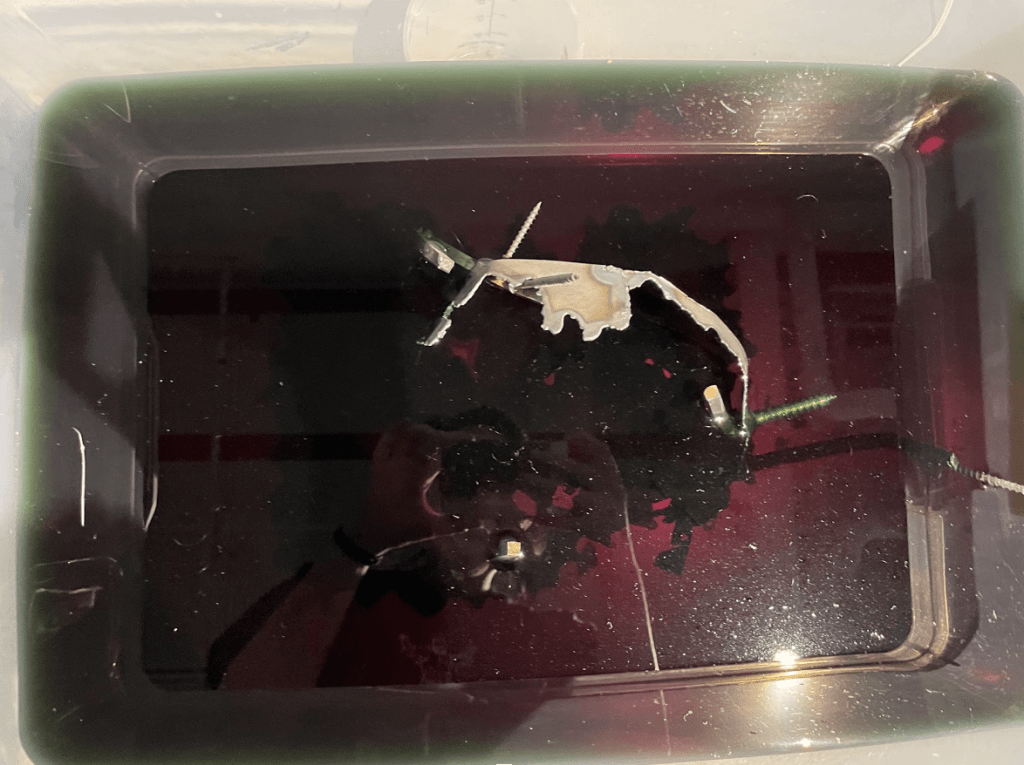
This piece connects to a work titled “Miniature Gowanus Canal” which I recently created in my sculpture class using metals and welding.

I welded small rods to a thin sheet of metal along with galvanized screws and nails to create an industrial underwater experience. I also cut the thin metal sheet at the bottom and used the remaining scraps to fashion a crown, which connects to Riley’s use of tampons, and Gidwani’s ideas of waste and value. By taking scraps to make something that is perceived as the ultimate luxury and value, I refute traditional ideas of what value is, and how a valuable piece should be treated by allowing my class members to wear it and play with it. For my showing of the Canal piece, I filled a plastic bin with water and placed it over a light. The light made the small holes and cuts in the metal shine through the perforations and illuminate the dark room. Furthermore, by using metal, compared to other materials, I connect to the industrial history of the canal, and the possible dangers it poses to people. Several areas of the metal are sharp enough to slightly cut viewers.
In my presentation of the work, I told the class a brief history of the Canal, guided by my own research and Riley’s map. I asked viewers to place their hands in the clear water, and touch the different metals. They are positioned in such a way that they look like seaweeds and reeds flowing in a current underwater. Then I added a mixture of toxic dyes and kombucha to the water, turning it into a vinegary-smelling tub. Tendrils of inky, foul-smelling color reached through the clear water of the tank, smothering the purity of the water. Small bits of plaster and human hair floated and sunk respectively. From the sides of the tank, it’s unclear what is in it but from above, the reddish glow of the canal and its underbelly are visible. Screws and nails poke out from under the water, and small bits of light peak through cuts in the metal plate at the bottom.
Viewers loved watching the water become murky, and remarked on the smell that now permeated the room. The metal also smells rusty and begins to change color, the edges turning black and purple. Viewers can once again choose to place their fingers in, however, they cannot escape this artwork because of the smell. By engaging multiple senses, I am not allowing viewers to turn away and ignore this piece, they must engage with it. I then placed the crown on top of the Canal, therefore completing the waste value dialectic by equivocating the two ideas of waste/toxicity, and value. Obviously, people can no longer dip their fingers into the Gowanus Canal because of its designation as a Super Fund Site. The majority of the Canal has been blocked off, crowded by construction workers. However, in my version of the Canal, it is still safe for viewers to place their hands in. Whether they wanted to, however, is a different story.
Viewers called my performance/piece cinematic, and eye-opening to how waste and degradation can be beautiful, which is how I felt viewing Riley’s work. Overall, the creation of art in response to/using discard studies principles advanced my understanding of the materiality of waste and gave my audience a different perspective on waste. Riley’s work made me question how I used materials for my own projects, and the importance of learning about them thoroughly, through their histories and methods of creation, which is especially apparent in the scrimshaws and sailor’s valentines. Through viewing Death to the Living: Long Live Waste, and Mierle Laderman Ukeles’ work and words, I am able to situate myself in a history of artful agitators.
Works Cited
Douglas, M. 2004. “Preface” p. x-xxi and “Introduction” p. 1-7 in Purity and Danger
Friedman, Alexandra Faye. “Miniature Gowanus Canal”. New York, 2022.
Gidwani, Vinay. 2012. “Waste/Value.” Barnes, T. J., Peck, J., & Sheppard, E. (Eds.). (2012). The Wiley Blackwell companion to economic geography. Pp. 275-288.
Ladermann Ukeles, Mierle. “Queens Museum: Maintenance Art.” Queens Museum | Maintenance Art, 1969, https://queensmuseum.org/exhibition/mierle-laderman-ukeles-maintenance-art/.
Riley, Duke. “Welcome Back to Wasteland Fishing, Episode Two”, 2019. Brooklyn Museum, New York.
Riley, Duke. “2). “If It Feels Good Do It”, 2020. Brooklyn Museum, New York
Riley, Duke, “ Poly S. Tyrene Memorial Maritime Museum series: Mike Durant” (No. 37), 2020. Brooklyn Musuem, New York.
Riley, Duke. “Duke The Fisherman’s High Quality Fluke Rigs Made in the USA ™”, 2020. Brooklyn Museum, New York.
Riley, Duke. “Gowanus Canal Triptych in Death to the Living: Long Live Plastic Exhibit”. Brooklyn Museum, New York.
 Alexandra Faye Friedman