In this essay, I explore Twitter, disability rights, and Elon Musk. I wrote this essay in my History of Media class, in Fall 2022. I learned about how to conduct research on social media, and how to use tweets as evidence. This has not directly impacted my art creation, however, thinking deeply and writing analytically are always important to becoming a better artist.
Twitter is more than something that rots your brain, and exposes you to the deepest darkest parts of the internet, where anger and frustration course through your blood like oxygen. There is something else there, especially for marginalized users, who connect through social media. Twitter allows for discourse between people who may not otherwise connect, as either siloed professors/intellectuals, or disabled users, who cannot get out much due to the ongoing pandemic. Twitter has been influential for several social movements and uprisings, such as #CriptheVote, the #MeToo movement, among many others. Twitter is the public square of the Anthropocene. Or at least it was.
Elon Musk purchased Twitter, and is subsequently tearing it down, which leads users like myself to wonder whether this forum of discovery and connection may be dying, and how we can save our own comfortable corners of the internet. In this essay, I explore Twitter before Elon Musk, and how this leadership shift will impact users now, focusing specifically on disabled users. Additionally, I question how Musk and his right wing followers interact, and what these parasocial relationships between everyday person and celebrity mean for the rest of Twitter.
To begin, in the article, “To See and Be Seen” by A. Marwick & D. Boyd, the authors explore what it means to practice celebrity on Twitter in the early aughts. The authors define it as the “practice of celebrity to them involves ongoing maintenance of a fan base, performed intimacy, authenticity and access, and construction of a consumable persona” (526). In this way, almost anyone can become a celebrity because of the openness of Twitter. For example, the user, @caucasianjames, is a regular guy. He is not a standup comedian, he is not an actor, he is not rushed by adoring fans when he goes in public, unlike most celebrities. Yet, he has over 1.5 million followers on Twitter for his regular posts of funny, often postmodern-ly ironic, internet humor. He has been actively creating content since 2011, and, like Boyd and Marwick dictate, he completes maintenance with his fans, retweets them displaying intimacy, and has a consumable persona of being a “caucasian James’ ‘. He even sells merchandise. However, because Caucasian James did not gain access to popularity through agents and other traditional forms of popularity and celebrity-hood, according to Boyd and Marwick, he would actually qualify as a microcelebrity (527).
At the time of writing this article, microcelebrity as a term meant civilians using Twitter, like myself, who utilized Twitter like a celebrity would, without being represented by an agency or using a publicist. But I believe this term is somewhat outdated because of the rapid increase in users becoming famous via social media, away from traditional routes. As a result of this, there is a new category if social media persona: the influencer. I do believe that a difference between influencers and micro influencers exist, in that 1 million followers versus 5k is different, however, the role of the influencer and the celebrity are no longer so different. The influencer sells a lifestyle, whereas a celebrity is ostensibly famous for some other reason, like a movie or tv show. But with the rise of TikTok, Twitter, YouTube, and Instagram grown influencers becoming celebrities, the line between the two grows blurry. The past ten years of development in social media has drastically changed who we as a society seek to emulate. People with more followers can be seen as more popular, and have more influence.
However, the influence of bots, or shadow accounts, can inflate the number of followers or subscribers that a social media user has. According to a PEW Research center study in 2018, “Twitter bots are accounts that can post content or interact with other users in an automated way and without direct human input”. This matters because these bots can be controlled by any group of people, from anywhere in the world, and they can also spread disinformation and malicious content through these posts. Bots are apparently why Musk chose to buy Twitter; he believed that Twitter would be better off without bots, and this would therefore make the platform more enjoyable for users. Additionally, Musk believes that bots spread disinformation, which gets in the way of Twitter becoming an open source news site, which Musk has stated he would like the platform to grow into (McCluskey).
However, according to Time Magazine, Musk’s own following is “roughly 48% are fake”, and many others with similar sized followings, such as Kim Kardashian or Bill Gates’ followers are almost half bots (McCluskey). Therefore, using the number of followers can be deceptive in trying to quantify the number of followers to make a celebrity. This leads us to ask the question: Is Elon Musk a celebrity? Through Boyd and Marwick’s definition…. Kind of. If being the child of a blood emerald empire, or being a rich nepotism baby counts as a traditional media connection, then yes. However, Musk has had publicists for several years, which again points to him being a traditional celebrity.
In order to answer this question more thoroughly, we will go through Musk’s Twitter to understand how this impacts his celebrity and status amongst his fans. He interacts with his fanbase, of mostly right wing and conservative figures, through tweets and retweets, mostly interacting with those who have invested in his companies or praise them (figure 1A and 1B).


According to Boyd and Maverick, these conversations between fans and famous people are public and visible, and involve direct engagement between the famous person and their followers. The fan’s “ability to engage in discussion with a famous person de-pathologized the parasocial and recontextualizes it within a medium that the follower may use to talk to real-life acquaintances” (Boyd and Maverick 530). Through these parasocial relationships, Musk elevates his followers’ sense of self and self importance, by connecting to “genius” billionaire, who they seek to emulate. Furthermore, by choosing to interact predominantly with right leaning users, Musk gives power to those who already have it within American society, and brings the public square deeper into the throes of facism.
Notoriously, Elon Musk tweeted his support for Republicans to win the midterm elections for “balance”, and encouraged the supposed red wave that never materialized (Figure 2).
Through this strategic elevation and re-platforming of figures like Donald Trump, Andrew Tate, and Jordan Peterson, Elon Musk is encouraging Twitter to become something it is not. Or at least, has not been. Twitter is progressively becoming more right leaning, and decaying as a platform, with more delays and less content from leftist and liberal groups/individuals either leaving Twitter or being banned through doxxing, or co. According to internal data collected by Twitter prior to Musk’s takeover, Twitter’s algorithm does promote right leaning content, however, with all of the changes Musk has made, it appears that it is even more so now (Huzsar). As a user myself I have noticed an influx of conservatives in my feed, which changed since Musk’s arrival, which is anecdotal, but until there is more data released by Twitter, it is all the data I have. Some examples of centrist or liberal celebrities who have left Twitter include Pedro Pascal, Whoopi Goldberg, and Gigi Hadid, among others. Most of them left due to changes in Twitter’s policies regarding hate speech and abuse. According to the New York Times, Musk fired many contractors who work on content moderation which monitors abuse (Conger, Mac, and Isaac). Additionally, under Musk, the policies regarding misgendering, or deadnaming trans people as reason for account suspension has been deleted. Musk cares for free speech hate speech, which can be seen as his reasonings for many of the changes he makes at Twitter.
Other such examples of Musk’s white supremacist views lie in his repeated use of Pepe the Frog, a meme spread on 4chan. Additionally, Donald Trump was originally banned for his use of Twitter to cause a violent and deadly insurrection on January 6th, which Musk then created a poll to see the percentage of Twitter users would want him back. Of the 15 million accounts that responded to the poll, 48% did not want Trump to return, whereas, 51% did (figure 3).

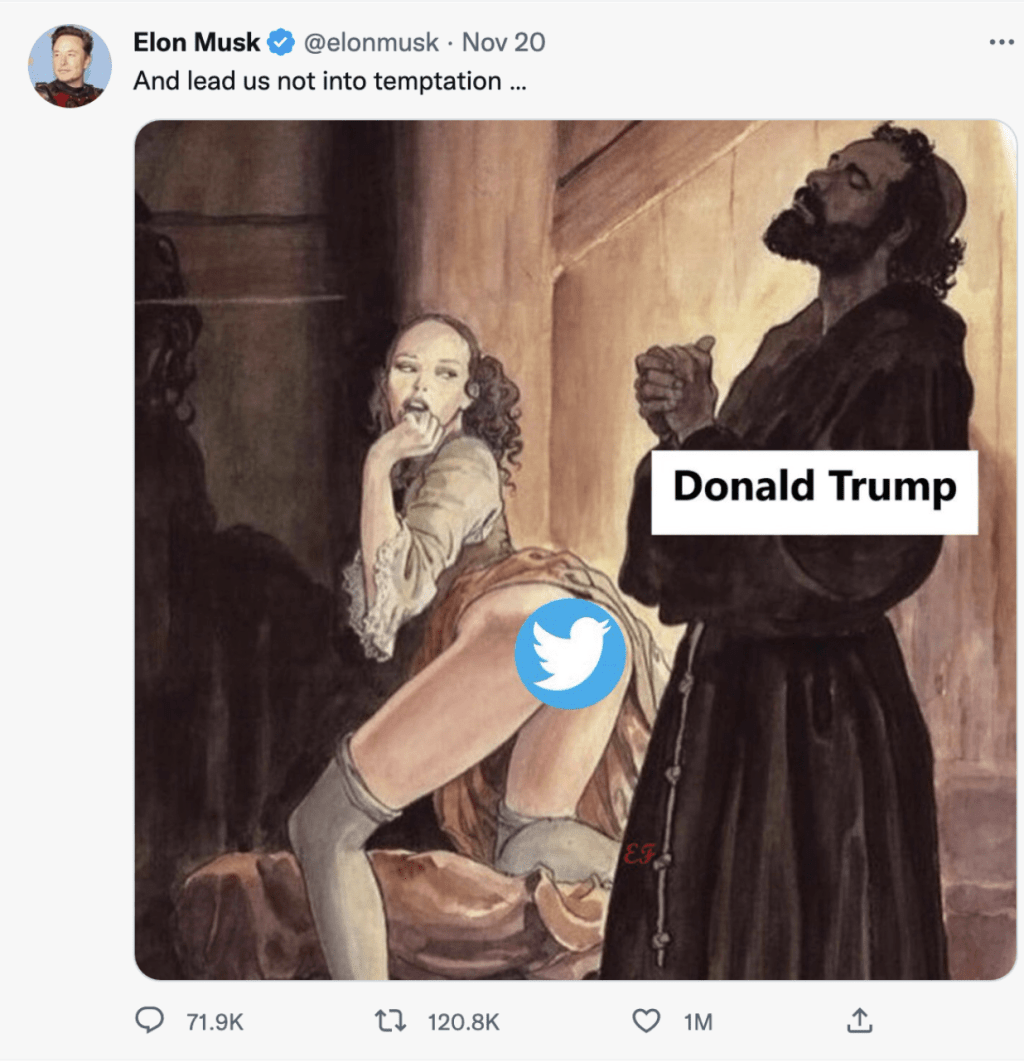
This led Musk to reinstate Trump, who has not yet tweeted on the platform. Musk has taunted Trump through memes, one of which includes a monk looking man, labeled “Donald Trump”, pacing beside a woman who cowers with her bottom uncovered, labeled with the Twitter blue bird icon (figure 4).

Musk titled the tweet “and lead us not into temptation …”, which is very biblical, and rape-y. This tweet also asserts that Trump is in some way like a monk, either through his values or spirituality, which is a right wing talking point. Furthermore, it is a deeply misogynistic image, through the lack of agency the woman in the image has, and implies that Twitter too is in the same position as her, which is altogether confusing, especially coming from Musk.
Beyond Musk’s own actions, Twitter users themselves have been emboldened to attack others on the platform. There is currently a list of “5000 antifa accounts” circulating right wing circles, which right wing users are attempting to deplatform through a mass reporting campaign, according to Philip Lewis, a senior front page editor at the Huffington Post (figure 5).

By reporting accounts, or spamming them, this leads to automatic suspensions of accounts being spammed. The users range from actual anti-facist activists to Black journalists to people in academia to the Auschwitz memorial Twitter account. The list includes Quinta Brunson, writer of hit TV show “Abott Elemnentary”, Eric Feigl-Ding, an epidemiologist and former Harvard professor, Britney Spears (who needs no background), and numerous smaller openly queer and diasbled account users who are not activists or public individuals/intellectuals. They just happen to be queer with public Twitter account, many of whom have since become private in fear of retribution from users and bots alike. These kinds of lists have been utilized since GamerGate to incite fear and create a kind of informational warfare that has only evolved more since the proliferation of bots by governmental powers, and ordinary people. This comes at the same time that Musk is allowing almost all banned users to return to Twitter, like Jordan Peterson, Kanye West, Donald Trump, and the Babylon Bee, many of which harbor transphobic, racist, ableist, and homphobic views. As Musk continues to reshape Twitter in his own image, the user agreement, content moderation, and hate speech policies has been vastly altered, which now allows for more lenient perspectives on what constitutes hate speech, and how it is punished.
These changes all attack what Twitter and the internet has been for marginalized users for years. According to Eve Shapiro, in “Transcending Barriers”, she writes, “the use of the Internet as both a tool to communicate, reduce costs, and distribute information and as a space to organize activism, network, and foster collective identity has been revolutionary within the trans movement” (167). Twitter has changed the way that social groups organize, and have made information and services for the trans community on the whole more accessible (Shapiro 170). Additionally, “it fosters decentralized organizing and new tactics of protest” (Shapiro 171). Twitter is both a tool and a space for people to connect, which goes beyond the limits people generally associate with social media. Furthermore, “the Internet carries fewer consequences for members of highly marginalized communities; trans people do not have to be out to access the community” (Shapiro 173). Marginalized people can connect without facing the normal social consequences that exist in real life. Obviously doxxing and other toxic, violent actions exist, however, this is not the focus of Shapiro’s argument, and this is a relatively new phenomenon since GamerGate, which could be seen as the birth of the modern rightwing/Nazi movement in the U.S.
However, this idea of the difference between outside/”real” world interactions, versus the internet is a key point needed in order to understand what a lifeline Twitter is for disabled users. Writer, activist, and scholar, Imani Barbarin, aka @Crutches_and_Spice on social media platforms, wrote in her essay, “With Twitter Crumbling, It Feels Like The World Is Collapsing On Disabled People”, about the importance of Twitter as a disabled person. Barbarin opens her piece, “online spaces have been a lifeline in a world that seeks to erase and eradicate us. Even prior to the pandemic, platforms like Twitter helped us to feel less alone and gaslit by our experiences and allowed us to contextualize our experiences in a way that gave us peace.” Twitter created a shared community for disabled users to exist together in a way that was not possible prior to the Internet because of the experience of being disabled in the US, and the world. Disabled activists have long been part of the fabric of American activism, but at the same time, as Barbarin remarks, DEI officers at big companies often neglect disability as part of their “inclusion”, which only came after the pandemic, mass disabling event. In the comments section of Barbarin’s website, Cassandra writes, (figure 6), “Wow…just found your website through Twitter via #patientsarenotfaking….”

This displays how integral Twitter is for outreach inside and out of the disabled community. Barbarin’s work as an educator and public intellectual challenging perceived notions of disability, and providing commentary that demonstrates the best that Twitter can be: educational and community oriented.
Barbarin has used the hashtag #cripthevote, and has worked closely with the hashtag’s founders. The founders of the #cripthevote movement are Alice Wong, sociologist and author of the Year of the Tiger, who worked in collaboration with Andrew Pulrang, and Dr. Gregg D. Beratan, to raise awareness in their various communities on the importance of disabled voters and issues. Americans with disabilities, before and after the pandemic, are the largest minority in the US, and yet, disability has been largely ignored since the passing of the Americans with Disabilities Act. Barbarin interviewed the three founders of the hashtag prior to the election in 2016 to discuss issues facing disabled people and why unity was important ahead of the election. Wong states, “I think social media has given lots of people like myself a platform of our own (although there is a lot of privilege and access involved). With social media, we can insert ourselves into conversations, share our views, and engage with a wide variety of folks with little interference by others. There’s something liberating about that. Journalists, who increasingly rely on Twitter to find out what’s going on, are discovering our voices and finally taking notice” (Wong qtd in Barbarin). Wong demonstrates that Twitter is not just for community; Twitter allows connections between people, like journalists, who may not otherwise have exposure to people like Wong.
At the time, in 2016, the conversation around disability was completely different because of perceived invisibility of disabled people, and the impact of the pandemic, which is again, a mass disabling event. As a result of increased exposure and conversations about disability, healthcare, accomodations/accessibility, discrimination, and employment, the founders of #cripthevote have decided to end their threads on Twitter using the hashtag. They state in their blogpost that through their online activism, “disability and politics discourse overall is much healthier, plentiful, and diverse than it was in 2016”, which is leading to the founders taking a step back (Wong et al). They are passing the digital torch to other creators, like Barbarin, to continue to share and advocate using the hashtag, or not, which has thousands of posts on Twitter associated with it.
The founders previously used #cripthevote to hold live discussions on Twitter to discuss topics such as assisted suicide, pandemic policy, the homecare worker crisis and many other topics. The three founders generally acted as moderators to address/ask questions to guest participants with an area of expertise on the subject. These events could really only happen on Twitter, because of its reach, and accessibility as a platform, which far outdid its competitors through alt-text, and a cutting edge accessibility team, that has since been fired during massive layoffs earlier this month. The accessibility team on Twitter was also composed entirely of individuals with disabilities, which is major for a tech company.
So how does Elon Musk’s celebrity impact the disabled community? What does the rising influence of right wing figures on Twitter tell us about the future?
Honestly, I don’t know. But I do know that Elon Musk continues to pander to Nazis, which places and disabled people, queer people, Black people, Jewish people, and every other historically marginalized and oppressed group under threat. To have a billionaire post a dog whistle (figure 7) on Novemeber 26th, “I wonder what the Earth will be like in 88 million years”, and because 88 is a Nazi code for Heil Hitler, this is a frightening subtext to Musk’s political leanings.

This could be a pure coincidence, however, in conjunction with Musk’s other tweets, and views, this is especially alarming for the direction we are headed in. Especially as several Nazis posted below other Nazi sentiments, alluding to the 14 words, the day of the rope, and other antisemitic views. We are living in dark times, with more Nazis and alt-right figures rising in popularity everyday. By Musk allowing, and encouraging these kinds of users to be on his platform, he is doing a disservice to all of us, and democracy.
Works cited
Barbarin, Imani. “Come on Crips, Let’s Get in Formation: #CripTheVote.” Crutches and Spice, 28 June 2016, https://crutchesandspice.com/2016/06/28/come-on-crips-lets-get-in-formation-cripthevote/.
Barbarin, Imani. “With Twitter Crumbling, It Feels like the World Is Collapsing on Disabled People.” Crutches and Spice, 13 Nov. 2022, https://crutchesandspice.com/2022/11/16/with-twitter-crumbling-it-feels-like-the-world-is-collapsing-on-disabled-people/.
Conger, Kate, et al. “Elon Musk Fires Twitter Employees Who Criticized Him.” The New York Times, The New York Times, 15 Nov. 2022, https://www.nytimes.com/2022/11/15/technology/elon-musk-twitter-fired-criticism.html?auth=login-google1tap&login=google1tap.
Hart, Robert. “Elon Musk Is Restoring Banned Twitter Accounts-Here’s Why the Most Controversial Users Were Removed and Who’s Already Back.” Forbes, Forbes Magazine, 28 Nov. 2022, https://www.forbes.com/sites/roberthart/2022/11/25/elon-musk-is-restoring-banned-twitter-accounts-heres-why-the-most-controversial-users-were-suspended-and-whos-already-back/?sh=32ee52c8385b.
Huszar, Ferenc, et al. “Algorithmic Amplification of Politics on Twitter | PNAS.” PNAS, 21 Dec. 2021, https://www.pnas.org/doi/10.1073/pnas.2025334119.
Lewis, Philip (@phil_lewis). “There’s over 5000 names on a so-called”antifa “ list”. November 25. 2022. Tweet.
McCluskey, Megan. “Almost Half of Elon Musk’s Twitter Followers Are Fake.” Time, Time, 28 Apr. 2022, https://time.com/6171726/elon-musk-fake-followers/.
Musk, Elon (@elonmusk). “The People have spoken. Trump will be reinstated. Vox Populi, Vox Dei. Noevmeber 29,2022 . Tweet.
Musk, Elon (@elonmusk). “Correct”. November 29,2022 .Tweet.
Musk, Elon (@elonmusk). “I wonder what the Earth will be like in 88 million years”. Noevmeber 26,2022 . Tweet.
Musk, Elon (@elonmusk). “I recommend voting Republican”. Noevmeber 7,2022.Tweet.
Musk, Elon (@elonmusk). “And Lead us not to temptation”. Noevmeber 20,2022 . Tweet
Musk, Elon (@elonmusk). “Reinstate President Trump”. Noevmeber 18,2022 . Tweet.
says:, Catherine, et al. “About.” Crutches and Spice, 8 Oct. 2017, https://crutchesandspice.com/about/.
Shapiro, Eve. “‘Trans’ Transcending Barriers.” Journal of Gay & Lesbian Social Services, vol. 16, no. 3-4, 2004, pp. 165–179., https://doi.org/10.1300/j041v16n03_11.
Wojcik, Stefan. “Bots in the Twittersphere.” Pew Research Center: Internet, Science & Tech, Pew Research Center, 17 Aug. 2020, https://www.pewresearch.org/internet/2018/04/09/bots-in-the-twittersphere/.
Wong, Alice. “#Cripthevote Blog.” #CripTheVote Blog, 27 November 2022, http://cripthevote.blogspot.com/.
 Alexandra Faye Friedman